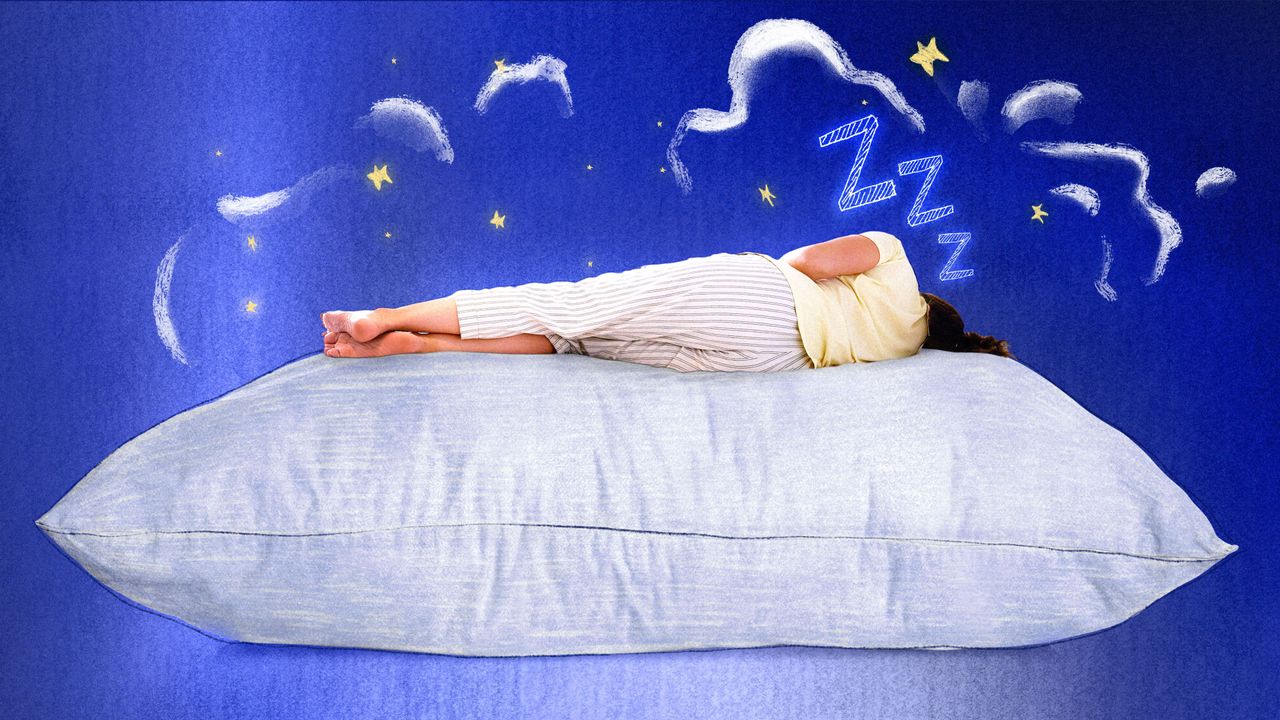
13 minutes ago Amanda Ruggeri BBC Serenity Strull/ Getty Images A woman asleep on a giant pillow, surrounded by a blue night sky (Credit: BBC Serenity Strull/ Getty Images) Just two hours of extra sleep can help reverse the damage from a bad night. But early nights and lie-ins should be wielded with caution. We've all been there: waking up, bleary-eyed after a bad night, feeling exhausted.
"It's fine," we tell ourselves. "I'll catch up at the weekend." A bit of extra sleep can be especially tempting for those of us who don't get enough during the week. Adults are generally advised to aim for around seven to nine hours , while it's thought that most adolescents need between eight and ten.
But that's not always possible. Which leads to the million-dollar question: if you aren't sleeping enough during the week, should you sleep in on the weekend? And if you do, can this blunt the effects of short sleep?
The risk of a lie-in To understand why sleeping in might have downsides, it helps to look at the two main processes regulating sleep. The first, the sleep homeostat , is like a "sleep tank". The longer we're awake, the more it fills with sleep pressure – and the more we feel like we need to lie down and snooze.
The second, our circadian rhythm, gets adjusted every day by our exposure to light and dark, temperature changes, even when we eat or move. These work together to make us feel sleepy, ideally at an appropriate time each night. How to Sleep Better Want to wake up rested and feel more alert?
Sign up to How to Sleep Better , our free six-part email course which features expert tips to improve your sleep. Catching up on sleep can knock both our sleep homeostat and our body clock off. This is true whether you go to bed earlier, or sleep in.
Because extra morning sleep reduces our sleep pressure later in the day, we might not feel tired until later that evening. And because we're not just sleeping at a different time, but doing everything else at a different time – including getting light exposure – it can affect our circadian rhythm too. The result?
We might sleep in Sunday morning and fall asleep later on Sunday night, so that when our alarm goes off at 06:00 on Monday, we haven't slept enough – starting the cycle all over again. "It's like shifting time zones every single week," says Melynda Casement, sleep psychologist and director of the University of Oregon Sleep Lab. However, though catch-up sleep should be used cautiously, it's not always a bad idea.
Here's when it might be helpful to get some extra rest. The benefits of recovery sleep How short sleep impacts our health and cognition is still being untangled. But in carefully controlled sleep restriction experiments, it's become clear that an especially rough night impacts our physiology.
And at least some of these consequences can be blunted, if not reversed, with catch-up sleep. In one study, for example, people who got only two hours' sleep for a single night showed higher counts of two types of white blood cells , potentially indicating a physiological stress response. Some participants were then granted an eight-hour sleep the following night.
But even after this, their white blood cell counts hadn't fully bounced back. However, participants who were allowed to sleep for up to 10 hours on the second day had levels which had nearly returned back to the baseline. BBC/ Serenity Strull/ Getty Images Catching up on sleep can help to reverse some of the physiological damage caused by a bad night (Credit: BBC/ Serenity Strull/ Getty Images) Another experiment studied what happened when 11 men who normally slept for eight hours each night were limited to four.
Six nights of short sleep were enough to impair their glucose clearance and insulin responses . If sustained long-term, these physiological changes can raise the risk of type two diabetes. But after six more nights of a 12-hour sleep opportunity, their measures had returned to baseline levels.
None of that means that a weekend lie-in (or early night) counteracts every effect of sleep debt, especially when short sleep persists over weeks or months. Vigilant attention (our ability to stay focused and respond quickly) and spatial orientation seem to be particularly vulnerable. In these cases, even weekend catch-up sleep can't fully reverse the effects of short weekday sleep.
Catching up on sleep, saving lives But these studies were conducted in artificial laboratory conditions. What happens when people catch up on sleep in the real world? For one Swedish study, researchers followed more than 40,000 adults over 13 years .
They found that adults under 65 years old who regularly slept for six to seven hours a night had the lowest risk of death. In comparison, those who slept five hours or less had a 65% greater mortality risk. For adults over 65, there was no association between short sleep and mortality risk – a result, the researchers suggest, of our sleep needs decreasing as we age.
But there was a twist. A decent weekend sleep appeared to erase the additional risk for the five-hour-or-less sleepers. If the short sleepers caught up then, statistically they had no higher risk of death than the people who slept a healthy amount during the week.
There is growing evidence that, for most of us, there seems to be a "sweet spot" of around one to two hours' extra sleep Even when short sleep's health impacts aren't reversed by catch-up sleep, they're often ameliorated. One study of almost 2,800 Korean adults, for example, found that habitually short sleepers were about 73% more likely to have high blood pressure. But each hour of weekend catch-up sleep was linked to about 17% less risk.
Other studies have found that short weekday sleepers who sleep in on weekends have a lower risk of dementia . They also have decreased risk of metabolic syndrome , a cluster of symptoms that raise your risk of type 2 diabetes or cardiovascular disease. More like this: Put together, these findings help explain why some scientists argue that waking up at the same time every day, no matter what, may backfire.
"Some people even go so far as saying, put on your alarm clock, even on weekends, so that you're regular," says Till Roenneberg, professor emeritus of chronobiology at LMU Munich's Institute for Medical Psychology, Germany. He disagrees. "Of course you have to catch up on sleep," he says.
"Sleep is one of the most important functions in our lives." The exception is people who have insomnia. The usual treatment for this condition recommends that people avoid both earlier bedtimes and lie-ins. This is true even after a rough night, as it can throw off their rhythms and make sleep even harder to attain.
A realistic sweet spot The next question is how much catch-up sleep you should have to maximise the benefits and minimise the downsides. Studies in the US and Korea have found this amount is associated with the lowest risk of depression. It's also been linked to lower inflammation in adults who are habitual short sleepers.
Researchers have found a similar pattern for younger people, including a lower risk of anxiety and depression . So, a little lie-in can sometimes be a good idea. But it probably won’t justify waking up at lunchtime. * Amanda Ruggeri is a journalist who explores the science, psychology and history of the ideas we take for granted.
She writes the six-part How to Sleep Better newsletter course , and her upcoming book, The Sleep Myth, will be published in summer 2027. * All content within this article is provided for general information only, and should not be treated as a substitute for the medical advice of health care professionals. -- For more science, technology, environment and health stories from the BBC, follow us on Facebook and Instagram .
Source: BBC